Run a hand the wrong way up a wirehaired back and the coat pushes back. It is meant to. The variety was bred to protect a hunting dachshund in thorny cover — a rough, thick mantle standing between the dog and the scrub it worked through. The FCI standard still lists the job before anything else: hunting dog, above and below ground. Everything about this coat follows from that line.
What the coat is made of
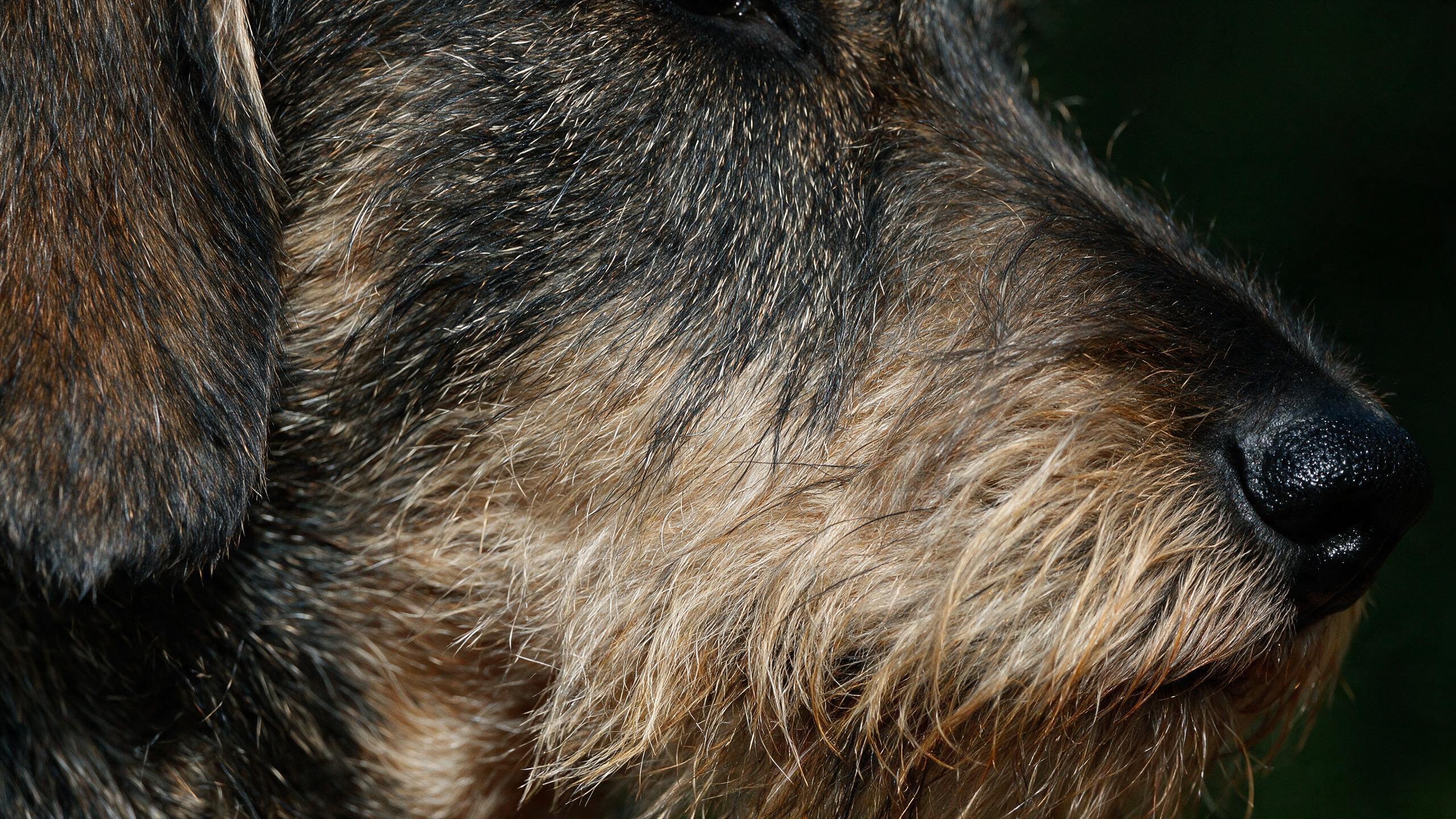
The standard describes it plainly. Except on the muzzle, eyebrows and ears, the body carries a perfectly even, close-fitting, dense wiry topcoat over an undercoat — two layers with two tasks. The harsh outer hair takes the wear; the undercoat beneath it holds the warmth. On the face the coat becomes expression: a clearly defined beard on the muzzle, bushy eyebrows above the eyes. The ears stay almost smooth.
The standard is also strict about softness where it does not belong — a soft topknot on the head is listed as highly undesirable. On a wirehair, harshness is not a flaw to be groomed away. It is the point. One more detail from those pages: wild boar, the grizzled colour many people picture on a wirehair, appears among the listed colours for this variety alone.
Care, honestly
Day to day, the coat asks for little. A brush a few times a week keeps the undercoat aired and the furnishings tidy; the beard appreciates a wipe after dinner. Washing is occasional, not weekly — the old house pages put it in one line: this coat does not need frequent baths.
What the coat does ask for is stripping. The harsh outer hair has a life cycle: it grows, it dies, and it is ready to come away. Hand-stripping is the removal of that dead hair — a few hairs at a time between finger and thumb, or with a stripping knife, in the direction of growth. The Dachshund Breed Council in the UK puts the rhythm at three to four times a year, and its advice on clippers is short: don’t shave a dachshund — it can harm coat and skin. Between strips, the brush does the maintenance.
We would rather show this than describe it. Our grooming practice — being documented.
Questions families ask
Does hand-stripping hurt? Done at the right moment, it is not a struggle. The old topcoat has already loosened at the root; taken a few hairs at a time, in the direction of growth, it comes away while the dog stands easy. A puppy that meets the routine early learns it as handling, nothing more.
Can we just have the coat clipped? Clippers cut the hair; they do not remove the dead coat. The breed council’s advice is to keep them away from a dachshund altogether. Find a groomer who works by hand — or ask us, and we will walk you through the routine before your puppy leaves.
How much work is it, honestly? Minutes with a brush a few times a week. A proper strip a few times a year — three to four is the rhythm the UK breed council describes. Little washing in between. It asks for knowledge more than time.
From the house
Francesca’s first dachshund was a wirehaired bitch, given to her at ten years old. She named her Favola and remembered, decades later, being struck by her look of “a little lion” — the beard and brows do that to a face. The coat runs through her notes as a mark of quality ever since: Penelopecruz carried a wild-boar black coat “so hard it seemed made of iron wire”; of GabrielGarko she wrote that “even stripped bare” he was without faults — a sentence only a breeder who strips her own dogs would think to write. And one small honesty from the old house pages: for all that thick coat, these dogs do not love the cold. A warm corner wins.
The coat is honest about what the breed is. We try to be the same.
More of the breed: the character underneath the coat and the three sizes it comes in.
Choosing well begins with a conversation. Introduce your family.