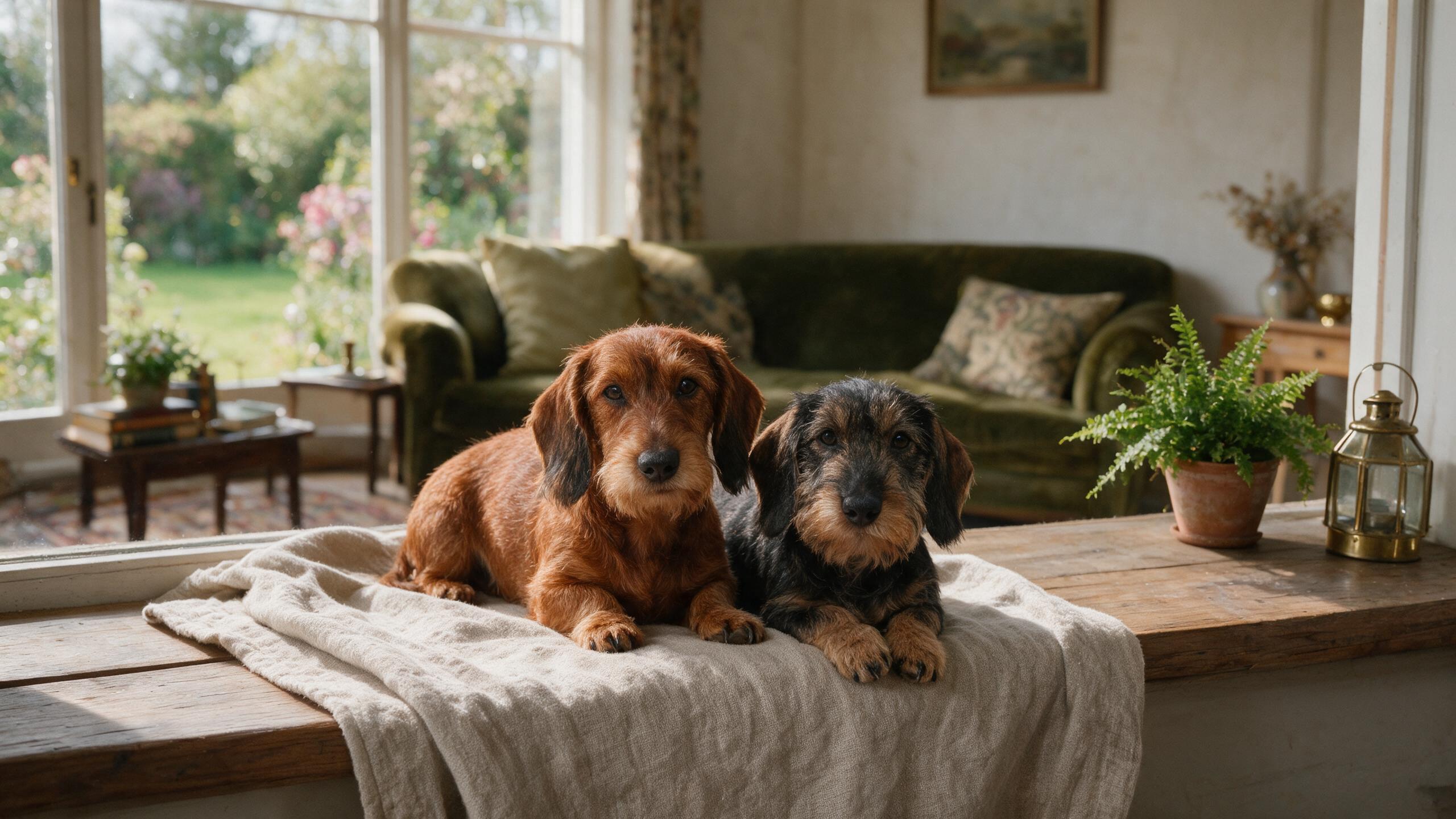
The wirehaired dachshund was bred for work, and the work explains the character. Sent below ground after badger, fox and rabbit, the dog hunted where no handler could follow and no command could reach. It had to read a situation and act on its own judgement. Most of what families love about this breed — and most of what surprises them — begins there.
Bred to think for itself
The FCI standard still lists the dachshund plainly as a “hunting dog, above and below ground”, and traces it to the short-legged German hounds bred since the Middle Ages for exactly this task. Underground, alone in the dark, a dog cannot ask what to do next. The dogs that did this work kept the habit of deciding first.
In a living room, that habit reads as independence. A dachshund hears your instruction, considers it, and weighs it against its own assessment of the moment. Owners expecting the instant compliance of a herding breed call this stubbornness. We would call it the mind of a specialist — one that answers to patience, consistency and early socialisation rather than to volume.
The official descriptions are worth reading for their honesty. The FCI asks for a dog “friendly by nature, neither fearful nor aggressive, with even temperament”. The British standard goes further: “intelligent, lively, courageous to the point of rashness”. Rashness, in an official document. That is the breed.
In the family
At home the hunter becomes something else: a small dog deeply attached to its own people. In our experience many choose one person as their point of reference and keep a particular eye on that person — an old instinct, redirected at the family. With strangers they are often reserved at first, and effusive greetings from people they do not know may go unappreciated. Early, calm socialisation is what turns reserve into good manners rather than suspicion.
Two practical truths belong in any honest account. The first is the voice: a wirehaired dachshund’s bark is bigger than the dog — strong enough, as the house book puts it, to be mistaken for a much larger animal. The second is the energy. This is a breed that needs to walk, sniff, dig and explore; a hunter kept only for the sofa tends to invent its own employment, usually self-appointed guard duty. Give the instinct somewhere to go, and what remains indoors is an alert, witty companion.
And children? Temperament is selected for and then shaped — it is not guaranteed, and we would rather say so plainly than promise you the behaviour of an individual dog. What we can do is what this house has done for almost forty years: watch each puppy’s character from its first weeks, and match the puppy to the family before anything else.
Questions we are asked
Is a wirehaired dachshund good with children? Often very good, with children who are taught respect for a small dog — but this varies dog to dog, which is why the match between puppy and family comes first here.
Are they difficult to train? They are quick to understand and slower to comply. Patient, consistent work from puppyhood gets there; raising your voice does not.
Do they bark much? More than their size suggests. The voice is part of the working inheritance; early habits, and enough to do each day, keep it within reason.
From the house
Francesca’s first wirehaired dachshund arrived when she was ten — Favola, a puppy with the look of a little lion, whose intelligence, elegance and frank self-regard set the pattern for everything bred here since. Years later her son Gabriel grew up alongside Jacqueline, a house dachshund who appointed herself his babysitter and bodyguard, and let no stranger come close. It was Gabriel, watching the dogs, who described the wirehaired dachshund as a small avenger — always vigilant, out to prove that size decides nothing. The kennel’s name took its final shape after that observation. Almost forty years on, it still holds. Jacqueline and the boy appear again in the story of the house.
The character is the breed’s oldest inheritance — older than anything in the archive. If it sounds like your kind of dog, read about the wire coat, or introduce your family. Choosing well begins with a conversation.